I started this post a long while ago, and never finished it. I find myself ruminating on it again, as I continue to move through and process old and new wounds, and do that thing called healing. (ick.)
I shared a meme to my Instagram stories a while ago that said
i basically assume that people don’t like me unless they explicitly tell me they like me and then periodically remind me
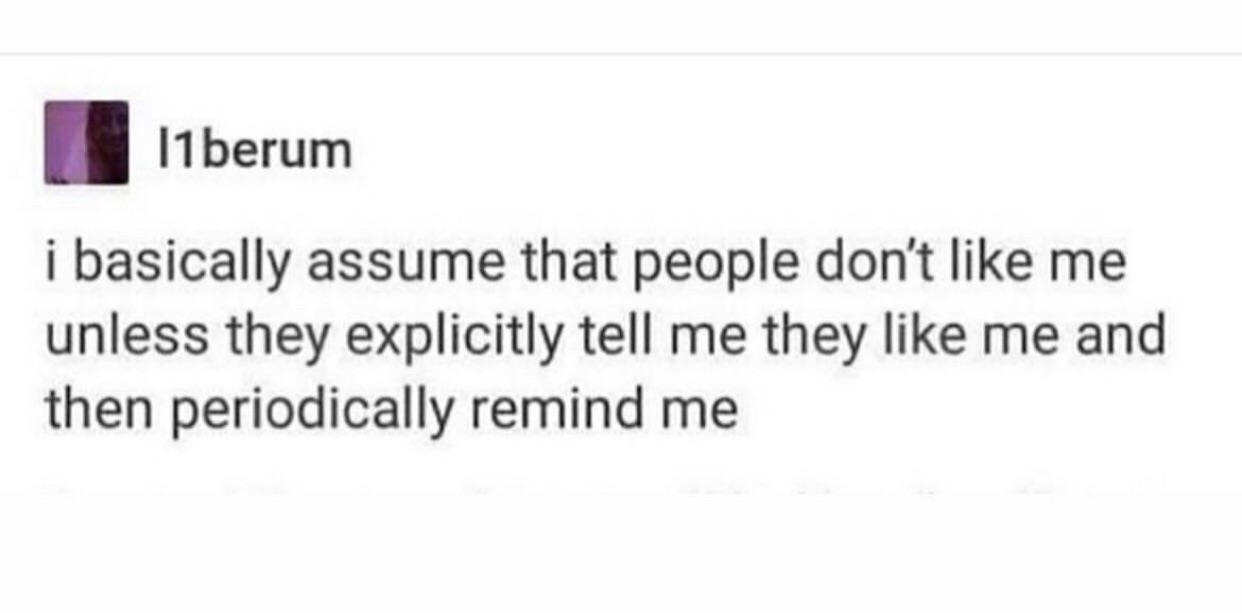
I shared it to be funny, but also because it’s true. My default assumption is that I am not most people’s cup of tea. I’m black coffee in a sugary coffee world. I never assume I’ll be liked, and so I’m pleasantly surprised when I am.
In response to the story, several people told me I’m very likeable, which was sweet and made me smile. Being reassured of my likeability also sent my brain into a fun little dialogue, a lovely tug-of-war between belief and doubt of the truth of the likeability, and another little bit of tension, a thorny part of me that says, “So what if I’m not?”
From a young age, I felt like I was a “bad girl” and that, no matter what I did, I couldn’t be good. I tried, still, but knew, somewhere in my bones, that pleasing people wasn’t something I could do, not for long, because of my inherent unpleasantness.
From a young age, I assumed people would dislike me at best, hate me at worst, no matter what I did. Because I was convinced of my unlikability, I decided that I would just be outspoken, honest, and direct and give them a reason for their dislike.
Ironically, I was also a people pleaser, and in many ways am still recovering from that. My people pleasing wasn’t connected to thinking people would like me; instead, I just hoped to be useful because at least then, people would want me around. If I was useful, maybe people wouldn’t be angry with me, and, even though they probably wouldn’t like me, at least they would tolerate me and keep me around.
My people pleasing habits rarely extended to censoring my opinions, though: just my feelings and my needs. My people pleasing only extended to people I liked, people I cared about. I wasn’t concerned with pleasing strangers, with pleasing authority figures (unless it was my parents when I was young, or a beloved professor when I was in college). The people I loved, though, I desperately needed them to be pleased with me. In order to be pleasing, I knew I had to be useful, to ask for as little as possible, and to go along with what others wanted of me.
As I got older, and started to wear my unlikability as armor, I discovered that being disliked can actually be freeing, in spite of the hurtful isolation of it all. Assuming that dislike would be the reaction to me created a sort of perverse self-assurance that allowed me to be outspoken and to stand in my own values.
This is what knowing you’re unlikable will do for you: allow you to speak up to authority without fearing rejection, because you have already been rejected.
And yet, and yet, and yet…
every rejection hurt, and every rejection still hurts. Every time my unlikability was (and is) confirmed, I buried myself more deeply and used each instance as proof that I needed to be small.
Anyone who has known me for long will laugh at the idea of me being quiet, of me being small (#sorrynotsorry to my grad school classmates, and to my exes) because I’ve always been so LOUD. So contrary. So blunt. So critical.
I was and am all of those things.
In all of this, I’ve realized that I’m quite tired of myself, of navigating my hurts and my triggers and tired of not being able to look away, tired of not being able to let go and get over things.
I’m tired of my needs and my emotions.
I’m just tired and that armor of unlikability is too heavy.
I don’t know how to end this post. I don’t know what point I’m trying to make. I’m not looking for a bunch of people to say how much they like me or dislike me… I don’t need the lines about learning to love myself.
I’m just tired of being the unlikable people pleaser, who can’t even please herself.
 Ink and Vein