From the first pages of Pam Houston’s latest book, Animals Taught Me Everything,1 I knew it was going to be one that I recommend to people with the words, “This will wreck you in the best possible way.”
Which, if you know me, you know that’s one of my favorite types of book to read.
Animals Taught Me Everything had me crying from the first paragraph, and kept me crying throughout the chapters. While I wept, though, I also could feel something in my heart yearning, longing, healing, and hoping. And really, this is why I like books that wreck me: in the emotional turmoil and catharsis, I can access clarity.
Several sections of the book take place during the COVID-19 lockdown, or reference back to that time.2 Houston contracted COVID and afterwards, like many of us, struggled with long COVID and also fought against the heaviness and despair that pulled at all of us as we watched our government take actions that violated basic human rights and actions that were motivated by greed and a seeming desire to destroy our world.
As many of us probably do, I related to this. During and since COVID, I’ve found it increasingly difficult to live in the world as it is. Unlike some (and like many others) I’ve been acutely aware of the problems for quite some time, and the heightened cultural awareness that came with COVID and afterwards twisted something in me that released some anger, but also released immense grief. Why had it taken something like this for people to notice? Why was so much horror required for the privileged to care about those without? And why were some of our world leaders intent on making it worse instead of getting to work to fix it? I was pushed near to breaking, and I did break. And I’m still figuring out how to come fully back together.
I’m learning that time outside is one of the ways I can accomplish this.
Houston expresses so much of this grief, this heaviness, as she writes about her life with animals. She pulls up the grief of her childhood, and the horrific abuse she endured at the hands of her father, while her mother stood by. This grief and her current grief are linked. All of our wounds, personal and societal, are connected.
The book begins with a list of “how tos” that animals teach us: how to fly, how to work, how to rest, how to love, how to forgive, how to play, how to die, how to be present with the living, with the dying, and with the Earth. How to hope against all odds. How to make a good day out of a sad day.
How to listen. The way a dog listens when coyotes begin to sing. The way a dog cocks his head at the sound of a person’s car, even when the muffler is new. The way my wolfhound Livie – dear gone girl – could hear the crack of a banana peel from two rooms away. The way a horse keeps listening for the whinny of his pasture mate, hours after the trailer has driven away. The way a horse listens not only with his ears but with his heart. The way a lamb listens for the bleat of her mother. The way the mother listens back. The way a crow listens for the wingbeat of his partner. The way the young humpback listened to my friend Jay play his harmonica, alongside our sailboat in the Tolmie channel, on our way from Bella Bella to Hartley Bay, and how that whale eventually began singing, too.
I was already crying after the first sentence of this paragraph. Perhaps because my heart, soft under whatever armor I’ve put on to get through the day, always cracks open when I look at animals and a bit of joy pours in. When I hear dogs join in with coyote song, throwing their heads back, throats fully exposed in reckless abandon, something in me wants to throw back my head and howl, too.
It brought me back to visiting a bat colony above the San Luis Valley, and listening in the quiet of sunset to hear the sound of their wings beating in the air, every wing flap pulling together tattered flaps of my soul.
The rest of the instruction on listening pulls at my heart because every act of listening described is one born from love. Listening for one’s person, pasture mate, mother, child. Listening to music and returning the gift with a song of one’s own. Listening as an act of attention, intention, and commitment to another. Listening as reciprocal.
Other parts of this opening chapter resonate as well:
How to rest. See how the four-month-old rescue pup flops on the grass after being rolled by her big brother four hundred times in a game of chase that lasts an hour. Be that flop, when you close your computer and turn off the light at ten o’clock at night, even if the emails are not answered, even if the essay is not revised.
Envision loving yourself on a day when you are not actively useful.
How to forgive. Instantly, or if not instantly, as soon as you possibly can. Or never, if the injury is bad enough. Swear to never subject yourself to that kind of torture again.
How to be present with the dying. With your entire being. And with a willingness to tell them it’s okay to go. Say their name over and over. Tell them thank you for how well they took care of you. Tell them thank you for teaching you how to live. Have patience, for as long as it takes. This is one of those times when knowing how to ret comes in handy. This is one of the few times I have gotten resting right without shame.
How to be present with the living. With all of your attention. With all of your intention. With all of your senses engaged.
How to make a good day out of a sad day. Go outside. Listen to the wind in the tops of the ponderosa. Watch the bald eagle who returns to the ranch every second year skim the sparkling surface of the Rio Grande. Sit by the creek behind the homesteader’s cabin and note how the water in the creek and the ghosts who occupy the ranch are always in conversation. Stare at the snow-covered mountain, and the living forest and the ice crusted pasture, and think, it’s still here, it’s still here, at least for right now it’s still here. Open your arms as the dogs, exhausted from play, come barreling across the meadow toward you. Wag and wag and wag and wag.
I could quote pages and pages of Pam’s writing, but, really, you should just read the book yourself.
She writes about saving a little lamb at the beginning of COVID lockdown, of her determination to do that one thing, despite the rancher’s wisdom that told her to let nature take its course. She writes about saving the lamb in the same chapter she writes about surviving the physical and psychological torture inflicted by her father. She writes about her grief over George Floyd’s murder. She writes that saving one small life is all she could do.
I am not any sort of a hero. I saved the ram because I thought maybe I could. I saved him because none of my heartfelt writing, nor my activism nor my passionate progressive values could save George Floyd. I saved him because cities are burning all across my country and because a man I can’t keep straight anymore from my dead father promised to do this to us, and now he is doing it every day. I saved the lamb to mitigate (if slightly) the wave of grief that is raining down on us, to prove to myself that I have both the strength and the stamina to save at least one small fragile thing. (13).
In connecting the trauma of her childhood abuse to the trauma inflicted on the nation by the then (and now) president, Houston reflects what many abuse survivors felt. Many of us who lived on eggshells, who had to be hypervigilant to make it through the day and night, who had to be attuned to every shift in mood — even though we knew, really, that even that hypervigilance would not save us — have felt the trap of that situation, again, as we navigate life in our nation. And, like Houston, we’ve realized that strength and stamina are really all that will get us through.
That’s really what it comes down to: enough hope to stay in the world, and the stamina, strength, and a dash of delusion to keep moving when hope is hard to come by.
Later, she writes:
There are a lot of people, my husband Mike is one of them, who are surprised by the extent and scope and rapidity of the destruction we are currently witnessing. I think this is because if you have never lived under the control of a monster, you do not exactly believe in monsters. Or, conversely, the desire to not believe in monsters is very strong until your survival depends on you doing so.
I was raised by a monster, and a monster’s enabler. And the most important thing I can tell you about a monster, the most important thing for us all to know right now, is that a monster will never be satisfied. (118)
Amidst this heavy realization, Houston still keeps living and going. She takes care of her animals, which include dogs, Icelandic sheep, horses, and a stubborn donkey. She takes us on safari in Africa, and on grueling, exhilarating horse tours in Iceland. These sections of the book where she regains her strength and her will to live through connecting with Icelandic horses are beautiful. She takes us with her as she figures out how to survive, how to live, in a world that is run by those who seem increasingly hostile to our existence.
Animals are here to help us live. I am absolutely sure of it. Not to the exclusion of being their beautiful brilliant wild and sentient selves, but because of it. Horses know, without even having to think about it, that deep connection and mutual care fill our tanks rather than deplete them. Generosity is its own reward, someone said a long time ago, not only because of some karmic equation, but because it is in the moment of giving that we are most full. All animals know this and would share that knowledge and so much more with us freely, if only we would stop exterminating them. (185).
This book is about what animals teach us about survival, but also what they teach us about thriving and living. Truly living involves reciprocity and intention. Animals teach us about what we owe each other, what we owe Earth, what we owe all living beings. Animals teach us that living includes pain, but it also includes joy and love, and giving ourselves up to joy and love when they come along.
- Animals Taught Me Everything by Pam Houston is published by Torrey House Press. It released on October 13th. Pam is currently on tour. You can see the locations, here. Catch her with the Narrow Gauge Book Cooperative, where I work, on October 16th at 6pm at Society Hall in Alamosa. ↩︎
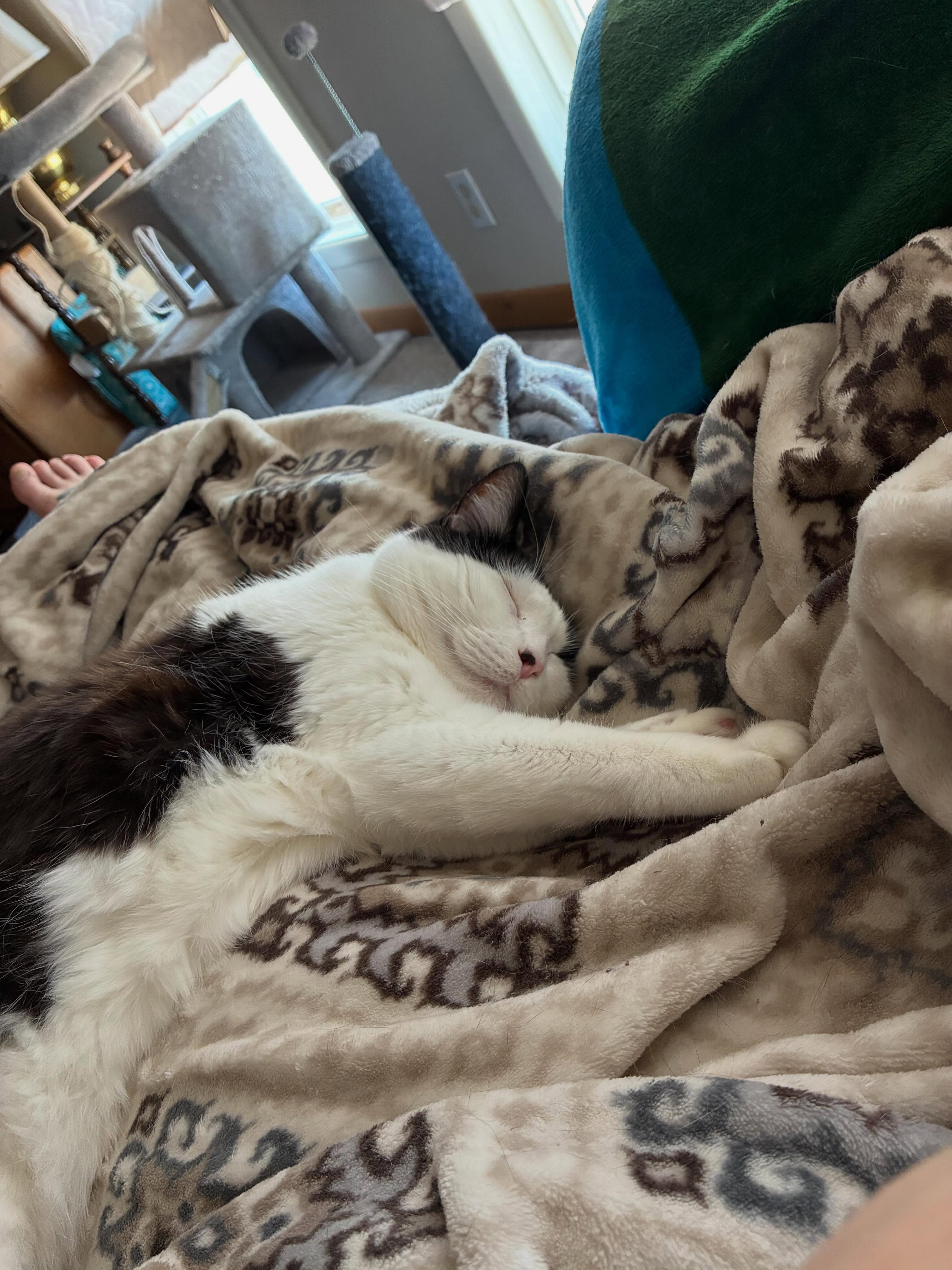
- Incidentally, I am writing this post while contorting my body and my laptop to accommodate my cat, Mabel, who is sleeping there. I adopted her during COVID, and, while not as grand as Icelandic horse riding adventures, she saved my life in many ways, and I love her. ↩︎